Cat Life is Better with Cat
A Designer’s First Glance: Charm Without Clutter
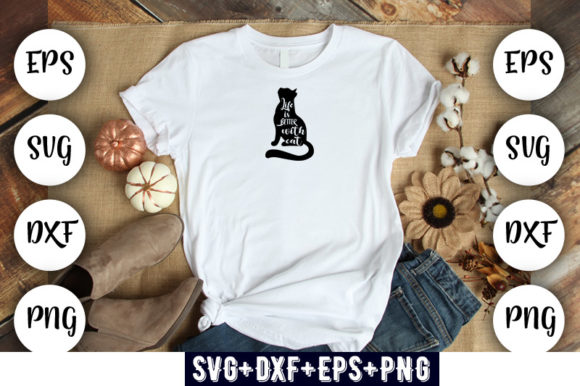
Opening Cat Life is Better with Cat feels like unrolling a well-loved sketchbook page — warm, confident, and instantly recognizable. It’s not fussy or overly detailed; the cat sits comfortably centered, ears perked, tail curled just so, with clean outlines and friendly, rounded lettering beneath. The composition breathes — no cramped corners, no awkward negative space — which tells me right away this was made *for stitching*, not just screen display. As a designer who’s seen hundreds of “cat-themed” graphics go sideways in embroidery, I appreciate how this one avoids visual noise. It leans into simplicity without sacrificing personality — exactly what makes a strong machine embroidery design for real-world use.
Where It Shines: From Tote Bags to Tiny Onesies
I recently tested Cat Life is Better with Cat on a natural linen tote bag for a local boutique launch — medium-weight fabric, light stabilizer, standard 4x4 hoop. The result? Crisp satin-stitched outlines, smooth fill-stitched body, and lettering that read clearly even from three feet away. No thread breaks, no puckering. That same file worked beautifully on a soft cotton sweatshirt (medium-density knit), and surprisingly well on a baby onesie — once I reduced size slightly and added lightweight tear-away stabilizer. It’s versatile enough for custom apparel, but thoughtful enough for delicate baby embroidery. I’ve also used it as an embroidered patch base (cutting around the shape post-stitch) and on tea towels — where the clean lines held up through repeated washing and ironing.
Why Craft Businesses Love This One
- It reads fast. Customers scanning a market table or Etsy listing get the message in under two seconds — no decoding needed.
- It scales well. From 2.5" on a cap brim to 5.5" across a pillow cover, proportions stay balanced — no distortion in letter thickness or cat silhouette.
- It supports brand voice. Whether you’re selling minimalist nursery decor or cheeky pet-themed merch, Cat Life is Better with Cat adapts without needing heavy redesign.
- It converts. In my small shop, items featuring this design consistently outperform similar phrases — likely because the cat adds warmth, not kitsch.
Where to Pause — Not Every Fabric or Fit Is Equal
This isn’t a “set-and-forget” design for every surface. On highly textured fabrics — think bouclé sweaters or thick terry cloth — the finer details (like the subtle curve of the cat’s whiskers or spacing between letters) can blur unless you adjust stitch density or add cutaway stabilizer. Thin or stretchy fabrics (jersey, rayon blends) need careful hooping and possibly a topping stabilizer to prevent thread sinking. And while the lettering holds up on dark fabric with good contrast thread, avoid ultra-fine fonts in the design’s smallest versions — they’ll vanish on black fleece or charcoal sweatshirts without testing first.
Curved surfaces like caps demand extra attention: I recommend digitizing a version with slight letter tracking adjustment if you’re planning high-volume commercial embroidery. Also, don’t assume it works flawlessly on layered garments (e.g., hoodies with thick drawcords near the chest area) — test placement on a mockup before committing to production runs.
Design Integrity Meets Real-World Trust
When customers see Cat Life is Better with Cat stitched cleanly on a handmade product, it signals care — not just in execution, but in curation. That matters. A sloppy or pixelated version erodes trust faster than any pricing mistake. This design, in its native vector formats (SVG, EPS, DXF), gives you full control to resize without loss — critical for printable mockups or resizing across product types. The included PNG is handy for quick previews, but never stitch from raster files alone.
What elevates it further: the balance between decorative and functional. It doesn’t overwhelm a garment, yet carries enough visual weight to justify a premium price point on boutique shelves or Etsy listings. For Etsy sellers and small shop products, that balance is gold — it invites engagement without demanding explanation.
Practical Notes Every Embroidery Designer Should Run Through
- Always test on scrap fabric — especially when switching from cotton to knit or from light to dark backgrounds.
- Check thread color contrast before stitching. Light gray thread on oatmeal linen? Gorgeous. Same thread on heather gray sweatshirt? Nearly invisible.
- Review stitch density — dense fills may cause stiffness on baby items or lightweight tees. Adjust if needed.
- Confirm hoop size compatibility — this design fits comfortably in a 4x4, but verify your machine’s max dimensions before scaling beyond that.
- Inspect small details at 200% zoom: are inner ear curves legible? Does the “C” in “Cat” have enough clearance from the cat’s head?
- Test black-and-white mockups — helps spot unintended shadows or muddy areas before stitching.
- Use proper stabilizer — tear-away for stable wovens, cutaway for knits, topping for napped or fuzzy fabrics.
- Verify licensing — since this is a digital embroidery file sold as Graphics, confirm whether resale of finished embroidered items or redistribution of the file itself is permitted before launching your craft business line.
Final Thought: It’s More Than a Phrase — It’s a Finished Feeling
Cat Life is Better with Cat doesn’t try to be everything. It’s not an applique design begging for layers, nor a complex monogram demanding five thread changes. It’s a confident, cohesive embroidery project starter — one that lands with sincerity on a holiday gift, adds quiet charm to nursery decor, and earns repeat orders from customers who recognize quality stitching when they see it. Whether you’re prepping for a craft fair, building your Etsy shop’s bestseller list, or designing a limited-run boutique collection, this design earns its place in your design assets. Just remember: respect the fabric, test the thread, and let the cat do the talking.